
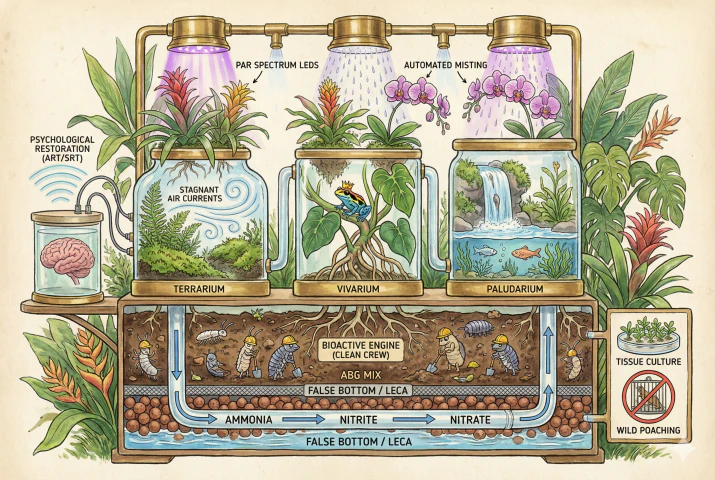
1. Introduction: The Intersection of Botany, Engineering, and Psychology
Indoor gardening has evolved far beyond simple decoration. What used to be a hobby of keeping plants on windowsills has transformed into a sophisticated discipline where botany, environmental psychology, and engineering intersect.
Driven by a fundamental need to reconnect with nature—often called “biophilia”—we are no longer just potting plants; we are building functional microcosms. From high-fidelity paludariums to self-sustaining bioactive tanks, these systems are designed to replicate the specific atmospheric and biological conditions of the wild.
We will explore the mechanics of stagnant air physiology, the biochemistry of “living” substrates, and the genuine psychological impact of bringing the outdoors in. Finally, we will address the hard truths of the industry: the myths surrounding indoor air purification and the rising ethical concerns regarding plant sourcing and biodiversity.
2. The Taxonomy of Enclosure: Defining the “Arium” Spectrum
To the layperson, the terms terrarium, vivarium, and paludarium are often used interchangeably to describe any glass vessel containing plants. However, within the specialized communities of herpetology and advanced horticulture, these terms denote distinct structural typologies with specific hydrological and biological parameters. Understanding these distinctions is the prerequisite for successful ecosystem management.
2.1 The Terrarium: The Terrestrial Greenhouse
Derived from the Latin terra (earth) and the suffix -arium (a place for), the terrarium is strictly defined as an enclosure for a land habitat. Its primary inhabitants are botanical—plants, fungi, and lichens—along with incidental microorganisms. The defining characteristic of a terrarium, particularly the “closed” variant, is its ability to maintain a self-regulating hydrologic cycle. Moisture transpired by plant leaves condenses on the enclosure walls and returns to the substrate, creating a high-humidity environment that mimics tropical understories.
Terrariums are further subcategorized by biome. A temperate terrarium may house mosses and ferns requiring cooler temperatures and seasonal dormancy, while a tropical terrarium maintains constant high heat and humidity. The “open” terrarium, often used for succulents and cacti, lacks this hydrologic cycle, relying on ambient room humidity to prevent the rot of xerophytic species which cannot tolerate the stagnant moisture of a sealed vessel.
2.2 The Vivarium: A Habitat for Sentience
While superficially similar to a terrarium, the vivarium (vivere, to live) introduces a critical layer of complexity: the requirements of zoological life. A vivarium is designed primarily as a habitat for animals, typically amphibians or reptiles. This shift in purpose necessitates a fundamental change in engineering. While a terrarium is designed to optimize plant growth—often prioritizing high humidity and stable temperatures—a vivarium must prioritize the physiological needs of its animal inhabitants, which may conflict with optimal plant care.
For example, a vivarium for Dendrobates (poison dart frogs) requires high humidity similar to a terrarium, but also necessitates specific barrier technologies to contain feeder insects (microfauna) and prevent animal escape. Conversely, a vivarium for arid reptiles (e.g., Pogona, bearded dragons) requires intense heat gradients and UVB radiation, creating a “dry” environment where only specific, hardy flora can survive. The key distinction is that terrariums replicate natural environmental processes for the sake of the ecosystem itself, whereas vivariums employ artificial aspects—heating pads, misting systems, UVB lamps—to support specific animal biology.
2.3 The Paludarium and Riparium: The Aquatic Interface
The introduction of a significant water volume creates the most complex enclosure types: the paludarium and the riparium.
The paludarium (palus, marsh) is a hybrid enclosure featuring both a significant terrestrial zone and an aquatic zone. Community discussions often cite a rough ratio of 50% land to 50% water, though this varies. The engineering challenge in a paludarium is twofold: maintaining the structural integrity of the “land” portion so it does not collapse or dissolve into the water, and managing the water chemistry of the aquatic section. Paludariums are often utilized for species that bridge these worlds, such as semi-aquatic crabs, newts, or turtles, necessitating filtration systems capable of handling heavy bioloads that would overwhelm a standard aquarium.
The riparium (ripa, bank/shore) is a nuanced subset often confused with the paludarium. While a paludarium constructs a landmass (e.g., a built-up rock pile or foam shelf), a riparium simulates the edge of a water body. In a riparium, the “land” area is often minimal or absent in the traditional sense; instead, marginal plants are suspended in planters on the rear glass, with their roots submerged in the water column and their foliage in the air. This setup mimics the littoral zone of a riverbank. The riparium is often easier to maintain than a paludarium because it eliminates the risk of soil substrate wicking water and becoming anaerobic, as the plants are adapted to wet feet.
Table 1: Comparative Analysis of Enclosure Typologies and Requirements
| Enclosure Type | Etymological Root | Primary Biotic Focus | Land-to-Water Ratio | Key Engineering Challenge | Typical Inhabitants |
|---|---|---|---|---|---|
| Terrarium | Terra (Earth) | Flora (Plants, Fungi) | 100% Land | Humidity regulation, mold control, condensation cycles | Tropical plants, Moss, Lichen |
| Vivarium | Vivere (To Live) | Fauna (Animals) | Variable (Species dependent) | Waste management, thermal gradients, escape prevention | Reptiles, Amphibians, Invertebrates |
| Paludarium | Palus (Marsh) | Hybrid (Flora & Fauna) | ~50% Land / 50% Water | Structural separation of land/water, dual filtration | Semi-aquatic amphibians, Crabs, Fish |
| Riparium | Ripa (Bank) | Marginal Flora | Mostly Water (Shore simulation) | Suspension of plants, water column nutrient dosing | Fish, Marginal/Bog plants |
3. Environmental Psychology: The Human Response to Indoor Nature
The proliferation of these enclosures is not merely a hobbyist trend but a reflection of deep-seated psychological needs. Extensive research in environmental psychology provides a theoretical framework explaining the benefits of indoor plants, centering on two major theories: Attention Restoration Theory (ART) and Stress Reduction Theory (SRT).
3.1 Attention Restoration Theory (ART) and Cognitive Resilience
Attention Restoration Theory, developed by the Kaplans, posits that human “directed attention” is a finite cognitive resource that depletes with use, leading to mental fatigue and reduced executive function. To replenish this resource, individuals require environments that elicit “involuntary attention” or “soft fascination”—stimuli that are effortless to observe but not overstimulating.
Indoor plants and terrariums serve as ideal sources of soft fascination. Studies involving high school students demonstrated that the introduction of plants into a classroom significantly increased the perceived “restorativeness” of the environment, which in turn had a strong positive effect on student mood. Further systematic reviews support this, indicating that indoor plants positively affect objective functions, particularly in terms of relaxed physiology and improved cognition.
However, the application of ART is nuanced. Research indicates that the quality of the natural intervention matters. A single dying pot plant may not offer the same restorative value as a thriving, complex ecosystem. The visual complexity of a terrarium—with its layers of texture, light, and movement—provides a richer “restorative experience” than simpler natural elements.
While some studies show a significant improvement in attention-related tasks in natural environments, others suggest that the primary benefit is not a direct boost in raw productivity, but a reduction in the cognitive cost of work, allowing for sustained performance over longer periods.
3.2 Stress Reduction Theory (SRT) and Physiological Recovery
While ART focuses on the mind, Stress Reduction Theory (SRT), pioneered by Roger Ulrich, focuses on the body’s autonomic response to nature. Ulrich’s research suggests an evolutionary basis for this: humans are hardwired to find non-threatening natural settings calming because they signaled safety and resources to our ancestors.
The clinical implications of SRT are profound. Studies have shown that surgical patients exposed to plants or views of nature experience faster recovery, require fewer analgesics, and report lower anxiety than those in sterile environments. Modern research utilizing Virtual Reality (VR) to simulate hospital rooms has isolated these variables, finding that the presence of indoor plants specifically increases “physical relaxation” scores, while window views of nature enhance “mental clarity”.
In the context of aquariums and paludariums, this effect is amplified by the presence of water. This is known as the “Blue Gym” effect. Research indicates that watching fish swim is associated with significantly lower levels of stress and anxiety, with controlled studies noting improved mood after just ten minutes of observation. The combination of greenery and water in a paludarium thus acts as a dual-modality therapeutic tool, targeting both the cognitive fatigue (via ART) and physiological stress (via SRT).
3.3 The Air Quality Controversy: Myths vs. Fluid Dynamics
A pervasive narrative in the general public is that indoor plants significantly purify air by removing toxins like benzene and formaldehyde. This belief stems largely from the 1989 NASA Clean Air Study. While the study successfully demonstrated that plants can metabolize volatile organic compounds (VOCs) in sealed, static chambers, its applicability to real-world environments is widely misunderstood.
Modern environmental engineering research has debunked the practical application of the NASA findings for typical homes. In a real-world building, the air exchange rate (ventilation) provided by HVAC systems or leaky windows is orders of magnitude faster than the rate at which plants can remove VOCs. A 2019 meta-analysis concluded that to match the VOC removal capacity of standard ventilation, one would need between 10 and 1,000 plants per square meter of floor space.
Therefore, while a densely planted terrarium contributes to air quality by regulating humidity (which can alleviate respiratory issues and reduce viral transmission rates), claims of it acting as a chemical air purifier are scientifically overstated. The primary contribution of indoor plants remains psychological and hygroscopic rather than toxicological.
4. Botanical Physiology in the Enclosed Environment
Cultivating plants in the stagnant, high-humidity environment of a terrarium requires a sophisticated understanding of plant physiology, particularly regarding transpiration, gas exchange, and photosynthesis mechanisms.
4.1 The Boundary Layer and the Stagnant Air Problem
A critical factor in terrarium botany is the boundary layer—a microscopic zone of still air adhering to the surface of a leaf. For a plant to photosynthesize, CO2 must diffuse from the air through this layer and into the stomata. Conversely, water vapor must diffuse out.
In the wild, wind disrupts this boundary layer, keeping it thin and facilitating rapid gas exchange. In a sealed terrarium, the air is stagnant. This causes the boundary layer to thicken, creating a significant resistance to gas transfer. This effect is compounded by the high humidity. Transpiration is driven by the Vapor Pressure Deficit (VPD)—the difference in moisture content between the leaf interior (saturation) and the surrounding air. When the relative humidity in a terrarium approaches 100%, the VPD drops to near zero.
Under these conditions, transpiration—the engine that pulls water and nutrients from the roots to the canopy—effectively halts. Without transpiration, plants cannot transport immobile nutrients like Calcium (Ca) to new growth, leading to tip burn and rot even in nutrient-rich soil. This physiological bottleneck explains why many hobbyists employ small computer fans within larger vivariums: not just to cool the tank, but to physically disrupt the leaf boundary layer and force gas exchange.
4.2 Adaptations of the Araceae (Aroids)
The family Araceae (Philodendrons, Anthuriums, Monsteras) dominates the vivarium hobby due to specific pre-adaptations. These plants often possess aerial roots, which in the wild allow them to climb trees and access moisture from the humid rainforest air.
Research comparing aerial roots to soil-formed roots in high-humidity environments reveals that aerial roots are significantly more efficient at nitrogen uptake. In a vivarium, this allows aroids to decouple from the substrate entirely. A Philodendron verrucosum can thrive attached solely to a piece of driftwood in a terrarium, provided the humidity is high enough for its aerial roots to function as the primary nutrient intake system. This physiological plasticity makes them ideal for the “vertical gardening” aspect of background planting in enclosures.
4.3 Bromeliaceae and CAM Photosynthesis
Bromeliads are another staple of the vivarium, prized for their ability to hold water in central “tanks” (phytotelmata). Many epiphytic bromeliads utilize Crassulacean Acid Metabolism (CAM) photosynthesis. Unlike C3 plants (most tropical foliage), which open their stomata during the day to intake CO2 (losing water in the process), CAM plants open their stomata at night. They fix CO2 into malic acid, storing it in vacuoles, and then close their stomata during the day to photosynthesize using the stored carbon.
This adaptation evolved for water conservation in arid environments or the “physiological drought” of the epiphytic niche (living on a branch where water drains instantly). In a terrarium, this makes bromeliads incredibly resilient to fluctuations in watering. However, CAM is energetically expensive. Consequently, bromeliads in vivariums often require significantly higher light intensity (PAR values) than surrounding ferns or aroids to maintain their coloration and growth form. If light is insufficient, the plant will revert to a green, elongated state (etiolation) as it attempts to find more energy, abandoning the production of photoprotective pigments (anthocyanins) that give them their vibrant reds and purples.
Table 2: Physiological Adaptations of Common Vivarium Flora
| Plant Family | Key Adaptation | Photosynthetic Pathway | Vivarium Implication |
|---|---|---|---|
| Araceae (Aroids) | Aerial Roots | C3 | Can grow without soil if humidity is >80%; susceptible to root rot in stagnant soil. |
| Bromeliaceae | Trichomes & Tanks | CAM (mostly) | Requires high light; water should be applied to the “tank,” not the roots; resilient to dry spells. |
| Polypodiaceae (Ferns) | Thin Cuticle | C3 | Extremely sensitive to low humidity; requires constant moisture but high airflow to prevent fungal issues. |
| Begoniaceae | Modified Leaves | C3 | Prone to “melting” (rapid rot) if water sits on leaves due to thick boundary layers. |
5. The Bioactive Engine: Soil Ecology and Microfauna
The most significant advancement in modern indoor husbandry is the shift from “sterile” setups to “bioactive” ecosystems. A bioactive terrarium is defined by the presence of a living soil food web that processes waste, cycling nutrients back to the plants.
5.1 The Nitrogen Cycle in the Terrarium
Just as in aquatic systems, bioactive terrariums rely on the nitrogen cycle to prevent the buildup of toxic waste.
- Input: Organic waste (fallen leaves, animal feces, dead insects) accumulates.
- Ammonification: Decomposers (bacteria and fungi) break down proteins into ammonium (NH4+).
- Nitrification: Specific bacteria, primarily Nitrosomonas and Nitrobacter, oxidize ammonium into nitrite (NO2−) and then nitrate (NO3−).
- Assimilation: Plants absorb nitrates through their root systems to fuel vegetative growth.
- Denitrification: In deep, anaerobic pockets of substrate, bacteria may convert nitrates back into nitrogen gas (N2), completing the cycle to the atmosphere, although plant uptake is the primary export mechanism in most terrariums.
Without this cycle, ammonia builds up in the soil, eventually reaching levels toxic to sensitive amphibians and causing root burn in plants.
5.2 The “Clean Up Crew” (CUC): Isopods and Springtails
The “engine” of the bioactive substrate consists of macro-decomposers, primarily Isopods (Crustacea) and Springtails (Collembola). These organisms are not mere scavengers; they are essential for the mechanical breakdown of waste, increasing its surface area for bacterial action.
Springtails (Collembola): These minute hexapods are the first line of defense against mold.
- Mycophagy: Springtails are primarily mycophagous (fungus-eaters). Research indicates that they actively graze on fungal hyphae, controlling mold outbreaks that are inevitable in high-humidity environments.
- Species Variations: The “Temperate White” (Folsomia candida) is the industry standard due to its parthenogenetic reproduction (cloning) and rapid growth rate. However, tropical species like Lobella sp. (Red Thai) are increasingly popular for their heat tolerance.
- Ecological Impact: Studies show that collembola grazing on mycorrhizal fungi can influence plant nutrient uptake, creating a complex feedback loop between the “bugs” and the plants they live under.
Isopods (Oniscidea): Isopods handle larger waste items.
- Taxonomy: The hobby distinguishes between genera based on behavior. Porcellio species (e.g., “Dairy Cows”) are fast, surface-active, and protein-hungry. They are efficient waste processors but have been known to bite soft-bodied inhabitants (like frogs) or delicate plants if their protein needs are not met. Armadillidium species (e.g., “Zebra Isopods”) are slower, tend to roll into balls for defense, and are less aggressive, though they may burrow more.
- The Dwarf White Standard: The species Trichorhina tomentosa (“Dwarf White”) is considered essential. It is a parthenogenetic burrower that is rarely seen, working deep in the substrate to aerate the soil and process root detritus.
Table 3: Functional Roles of Microfauna in Bioactive Systems
| Organism | Primary Diet | Ecological Function | Best For | Warning Notes |
|---|---|---|---|---|
| Springtails (Folsomia candida) | Mold, Fungus, Bacteria | Mold control, preventing fungal blooms | All Terrariums | Prone to desiccation; die if substrate dries out completely. |
| Dwarf White Isopods (Trichorhina tomentosa) | Detritus, Decaying Roots | Substrate aeration, deep soil nutrient cycling | All Bioactive Setups | Hard to remove once introduced; parthenogenetic. |
| Large Isopods (Porcellio spp.) | Feces, Leaf Litter, Protein | Rapid waste removal, visual activity | Reptile Vivariums | Can consume live plants or soft animals if protein-starved. |
| Armadillidium Isopods | Vegetable Matter, Wood | General decomposition | Temperate/Dryer setups | Prone to eating live moss; breed slower than Porcellio. |
6. Construction Mechanics and Substrate Science
The structural integrity of a terrarium relies on managing water physics. Unlike a flowerpot, a terrarium has no drainage hole. All water entering the system stays there until it is transpired or evaporated.
6.1 The ABG Mix Standard
The substrate must resist compaction and decomposition for years, as replacing it would destroy the ecosystem. The Atlanta Botanical Garden (ABG) Mix has become the global standard for this application.
- Recipe: Typically 2 parts tree fern fiber, 1 part peat moss, 1 part sphagnum moss, 1 part charcoal, and 2 parts orchid bark.
- Physics of the Mix: The tree fern fiber acts as a structural lattice that refuses to break down, keeping the soil “fluffy” and aerated even when wet. The charcoal provides a massive surface area for the colonization of nitrifying bacteria. The orchid bark creates macropores for drainage, preventing the anaerobic conditions that lead to the “swamp smell” of rot.
6.2 The False Bottom and Hydrostatic Barriers
To prevent the soil from sitting in excess water, a “false bottom” or drainage layer is engineered.
- Materials: Lightweight Expanded Clay Aggregate (LECA) or plastic egg crate (light diffuser grid) supported by PVC pipe.
- Wicking Prevention: A critical failure mode in terrariums is “wicking.” If the soil substrate directly touches the water in the drainage layer, capillary action will pull water up, saturating the soil and drowning plant roots (root rot).
- The Barrier: A synthetic mesh (typically fiberglass window screen) is placed between the false bottom and the substrate. This barrier must be fine enough to stop soil from falling through but porous enough to allow water to drain down. It physically breaks the capillary path, ensuring the soil remains moist but aerated, not sodden.
7. Hydrology and Chemistry in Paludariums
Paludariums introduce the volatile chemistry of small water volumes. A 10-gallon water section is far less stable than a 100-gallon aquarium.
7.1 “New Tank Syndrome” and Ammonia Spikes
When establishing a paludarium, the aquatic section undergoes a cycling process similar to an aquarium. “New Tank Syndrome” occurs when animals are introduced before the nitrifying bacteria are established. The animals produce waste (ammonia), which spikes rapidly because there are no bacteria to consume it.
- Mechanism: Ammonia (NH3) is highly toxic. In a new tank, it can kill inhabitants within days.
- Mitigation: The “Fishless Cycle” involves adding an ammonia source (like fish food) to an empty tank for weeks to feed the bacteria before adding animals. In emergencies, chemical binders (like Seachem Prime) can temporarily detoxify ammonia, but they do not remove it.
7.2 Filtration Challenges
Filtration in paludariums faces unique challenges. The terrestrial section sheds debris—soil particles, moss fragments, and peat dust—into the water. Standard aquarium filters often clog rapidly.
- Solutions: Design strategies include creating “retention barriers” using rocks or foam to physically separate the soil from the water edge. The use of coarse pre-filter sponges on pump intakes is mandatory to prevent impeller damage from soil grit.
- Botanical Filtration: In “riparium” setups, the plants themselves act as the primary filter. Because riparian plants have access to atmospheric CO2 (which is 400x more concentrated than aquatic CO2), they grow faster and strip nitrates and phosphates from the water more efficiently than submerged aquatic plants.
8. High-Tech Integration and Future Trends (2025)
The hobby is currently undergoing a technological revolution, transitioning from analog timers to app-driven automation.
8.1 Automation and IoT Integration
As of 2025, systems like the GOcontroll Moduline Mini and advanced MistKing controllers allow hobbyists to automate the entire ecosystem.
- Feedback Loops: Modern systems use sensors to create feedback loops. If the humidity sensor drops below 70%, the controller triggers the misting system. If the temperature exceeds 85°F, it triggers ventilation fans.
- Data Logging: These systems allow users to graph environmental data over months, identifying instability trends that might explain plant failure or animal stress.
8.2 Lighting Physics and PAR
The shift to LEDs has been absolute. However, the metric has changed from “watts per gallon” to PAR (Photosynthetically Active Radiation).
- Spectrum: Advanced lights now offer customizable spectrums. A typical “jungle” spectrum peaks in the blue (450nm) for vegetative growth and red (660nm) for photosynthesis efficiency.
- Intensity: High-end fixtures are capable of punching light down 24-36 inches of depth, allowing for the growth of demanding carpet plants (like Micranthemum ‘Monte Carlo’) on the floor of deep vivariums.
8.3 Aesthetic Trends: Aquatecture
“Aquatecture” is the emerging trend of integrating these ecosystems into the architectural fabric of a home—such as wall-mounted biospheres or room-divider paludariums. This is coupled with a move toward “Minimalist Aquascaping,” which rejects the chaotic “fruit salad” planting style of the past in favor of serene, Zen-inspired layouts using only one or two species of stone and plant.
9. Ethics, Sourcing, and Sustainability
As the hobby scales, the ethical sourcing of biological material has become a central debate.
9.1 The Tissue Culture (TC) Revolution
Historically, the demand for exotic plants (like rare Bucephalandra or Anubias) drove poaching, decimating wild populations in Borneo and the Amazon. The solution has been Tissue Culture (micropropagation).
- Process: Laboratories take a small tissue sample from a mother plant and grow it on sterile nutrient agar. A single sample can produce thousands of clones.
- Benefits: This mass production crashes the price of rare plants, removing the incentive for poachers. It also guarantees plants are free of pests, algae, and pesticides, which is critical for sensitive vivarium animals.
- Sustainability: TC is now the industry standard for sustainability, allowing the hobby to expand without depleting the rainforests.
9.2 Ethical Wildcrafting
For materials that cannot be lab-grown (like driftwoods, specific rocks, or local mosses), “wildcrafting” guidelines have emerged.
- The 10% Rule: Ethical harvesters never take more than 10% of a patch and never harvest the same patch twice in a year.
- Legal Peril: Hobbyists must be aware of local laws. Collecting carnivorous plants (like Sarracenia) from the wild is a felony in many US states. The community strongly polices this, with online forums often banning users who display wild-collected protected species.
10. Conclusion
The modern indoor ecosystem is a marvel of interdisciplinary integration. It is where the physics of fluid dynamics meets the biochemistry of the nitrogen cycle, framed by the aesthetics of landscape design and driven by the psychology of biophilia. Whether it is a simple moss terrarium offering a moment of “soft fascination” to a stressed student, or a fully automated, cloud-controlled paludarium housing endangered amphibians, these “ariums” represent a profound shift in how we relate to nature. We no longer just observe it; we engineer it, sustain it, and ultimately, invite it to live with us.
The future of this field lies in the continued refinement of the “bioactive” concept—moving closer to truly self-sustaining systems—and the ethical maturity of a community that increasingly recognizes its responsibility to conserve the wild habitats it seeks to replicate.
11. References and Community Resources
The following links provide deeper access into the active communities and foundational tutorials mentioned in this report.
Community Hubs
https://www.reddit.com/r/terrariums
Note: This subreddit is the central hub for general terrarium construction, troubleshooting, and aesthetic inspiration.
https://www.reddit.com/r/Vivarium
Note: Focused specifically on enclosures housing animals, this community is an essential resource for advanced bioactive setups involving amphibians and reptiles.
https://www.reddit.com/r/paludariumzx
Note: A specialized community for the complex “land and water” hybrid enclosures discussed in Section 2.3 and Section 7.
Expert Tutorials and Visual Guides
Note: A definitive guide by SerpaDesign on constructing False Bottoms (Drainage Layers), a critical structural component detailed in Section 6.2.
Note: A tutorial on mixing “ABG Mix,” the substrate standard for long-term bioactive ecosystems discussed in Section 6.1.
Note: An in-depth explanation of the Nitrogen Cycle in aquatic environments, crucial for understanding the “New Tank Syndrome” risks in paludariums (Section 7.1).
Note: A detailed look at Plant Tissue Culture, the sustainable sourcing method that is replacing wild collection for rare plants (Section 9.1).

Leave a Reply